CALL US NOW +971 55 2008296 | 02 6395477

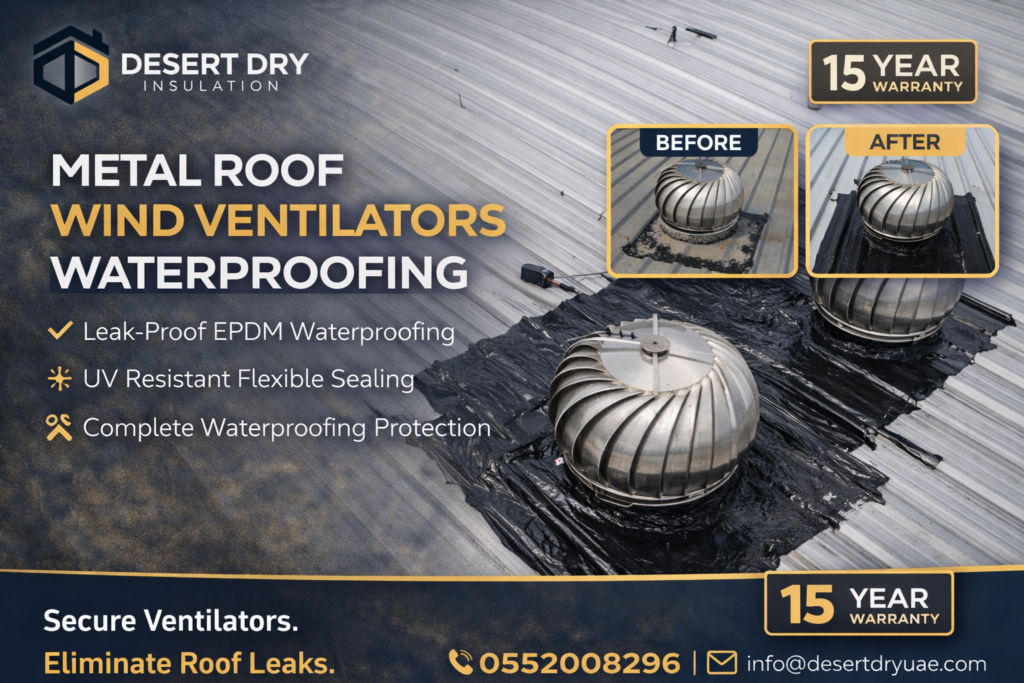
Why Metal Roof Wind Ventilators Leak?
Experts in Self-Driven Wind Ventilators & Power Wind Ventilators Waterproofing
Metal roofs are widely used for warehouses, factories, workshops, industrial sheds, and commercial buildings because they are durable, practical, and suitable for large-span structures. To improve ventilation and reduce heat buildup inside these buildings, many roofs are fitted with wind ventilators. These may be self-driven wind ventilators or power wind ventilators.
While wind ventilators are highly effective for air circulation, they are also one of the most common points where roof leakage begins. At Desert Dry Insulation Work, we often inspect buildings where water seepage starts around the base of ventilators, flashing joints, fixing points, or surrounding roof sheets.
Understanding why metal roof wind ventilators leak is the first step toward choosing the right waterproofing solution.
What Are Metal Roof Wind Ventilators?
Wind ventilators are roof-mounted ventilation units that help remove hot air, humidity, fumes, and trapped heat from inside the building.
Self-Driven Wind Ventilators
Self-driven wind ventilators work naturally using wind movement and air pressure. They rotate without electricity and are commonly installed on warehouses and industrial buildings to improve airflow.
Power Wind Ventilators
Power wind ventilators use electric motors or powered fans to force hot air and stale air out of the building. These are often used where stronger ventilation performance is required.
Both systems are useful, but both create roof penetrations, and every penetration in a metal roof is a possible leakage point if not sealed correctly.
Why Do Metal Roof Wind Ventilators Leak?
1. Poor Waterproofing Around the Ventilator Base
The most common cause of leakage is weak waterproofing where the ventilator meets the metal roof sheet. If the base flashing is not sealed properly, rainwater can enter through small openings and start leaking inside the building.
2. Failed Sealant at Joints
Sealants around wind ventilators are exposed to sun, rain, dust, and temperature changes every day. Over time, the sealant can crack, shrink, or lose adhesion. Once that happens, water can pass through the joints during rain.
3. Movement of Metal Roof Sheets
Metal roofs expand and contract because of heat and temperature changes. This movement can stress the joints around self-driven and power ventilators. If the waterproofing system is not flexible enough, cracks and separation can appear around the ventilator flashing.
4. Improper Flashing Installation
Flashing is one of the most important parts of ventilator waterproofing. If the flashing detail is not installed correctly, has poor overlaps, or leaves open edges, water will find its way inside. In many cases, the actual leak is not from the ventilator itself, but from the flashing detail around it.
5. Loose Fasteners and Fixing Points
Wind ventilators are fixed to the roof structure with screws, bolts, or other fastening systems. If these fixing points become loose, damaged, or poorly sealed, rainwater can enter through them. This is very common in older roof installations.
6. Water Ponding Around the Ventilator
If the roof slope is poor or dirt and debris collect around the ventilator base, water may remain in that area for a long time. Ponding water increases the risk of seepage through small gaps, weak sealant, or rusted joints.
7. Rust and Corrosion
When moisture remains around the ventilator flashing or fixing points, corrosion can begin. Rust weakens the metal surface and can create holes or damage the seal between the ventilator base and roof sheet. Once corrosion starts, leakage often becomes worse with time.
8. Poor Workmanship During Installation
A wind ventilator should not be treated as just an accessory. It must be integrated properly into the roof waterproofing system. If installation is rushed or done without correct waterproofing materials, the ventilator area becomes one of the first places to fail during rain.
9. Aging Roof Materials
Older metal roofs and old ventilator installations may already have worn-out flashing, damaged sealant, weak screws, and deteriorated surface coatings. These age-related issues can make even a previously leak-free ventilator start leaking.
Common Signs of Wind Ventilator Leakage
Your self-driven or power wind ventilator may be leaking if you notice:
Water dripping during rain
Damp marks around the ventilator opening
Ceiling stains below the ventilator area
Rust around the ventilator base
Cracked sealant lines
Visible gaps in flashing overlaps
Mold smell or damp insulation
Repeated leakage from the same point
These warning signs should be checked early before the damage spreads.
Why Leakage Around Wind Ventilators Is Serious
A leaking wind ventilator does not only affect the roof. It can also damage:
Insulation layers
Interior ceiling panels
Stored goods and materials
Electrical systems
Machinery and equipment
Structural metal components
In industrial and warehouse buildings, even a small leak can lead to costly damage and operational problems.
Why Temporary Repair Is Not Enough
Many building owners try temporary repairs such as applying ordinary silicone around the ventilator base. This may stop the leak for a short time, but it usually does not solve the actual problem.
A proper repair should include:
Inspection of the full ventilator base
Checking flashing joints and overlaps
Identifying weak fixing points
Removing failed sealant
Surface cleaning and preparation
Flexible waterproofing treatment
Sealing all surrounding vulnerable points
Without complete treatment, leakage often returns in the next rain.
Best Waterproofing Solution for Self-Driven and Power Wind Ventilators
The right treatment depends on the roof condition, ventilator type, and leakage source. In most cases, professional waterproofing includes:
Surface Preparation
All dust, dirt, rust, loose particles, and old failed sealant must be removed before waterproofing begins.
Flashing Joint Treatment
The base flashing and all connection joints around the ventilator should be inspected and sealed properly.
Flexible Waterproofing Materials
Since metal roofs move with heat, the waterproofing system should remain flexible. High-performance systems such as EPDM waterproofing, reinforced joint sealing, or specialized metal roof waterproofing treatments are often ideal for ventilator areas.
Fixing Point Sealing
All screws, bolts, and fastening points should be checked and sealed to prevent water entry.
Edge and Corner Protection
Corners and overlap points around the ventilator are highly sensitive and require careful waterproofing.
Expert Waterproofing for Wind Ventilators
At Desert Dry Insulation Work, we provide specialized waterproofing services for:
Self-driven wind ventilators
Power wind ventilators
Ventilator base flashing joints
Roof penetration waterproofing
Metal roof overlap and joint treatment
Leakage rectification for warehouses and factories
Our team understands that every roof penetration is a technical detail that must be treated professionally for long-term performance.
Why Choose Desert Dry Insulation Work?
We provide reliable waterproofing solutions for metal roofs, flashing joints, penetrations, ventilators, skylights, gutters, and expansion joints across Abu Dhabi, Dubai, and the UAE.
Our focus is on:
Proper inspection
Durable materials
Flexible waterproofing systems
Expert application
Long-lasting protection against leakage
Conclusion
Metal roof wind ventilators leak mainly because of poor sealing, flashing failure, roof movement, loose fasteners, rust, or aging waterproofing materials. Since both self-driven wind ventilators and power wind ventilators create openings in the roof, they must be treated carefully with a professional waterproofing system.
Ignoring leakage around ventilators can lead to interior damage, rust, and repeated repair costs. Proper waterproofing helps extend the life of the roof and keeps your building safe during rain.
Contact Desert Dry Insulation Work
Need expert help for Self-Driven Wind Ventilators & Power Wind Ventilators Waterproofing?
Desert Dry Insulation Work
Call / WhatsApp: 0552008296
Email: info@desertdryuae.com
Protect your metal roof ventilators before small leakage becomes a major problem.